“Give me a recipe idea”: 7 pm, the AI fills Home, her husband taps “I take it” — dinner at €4.87
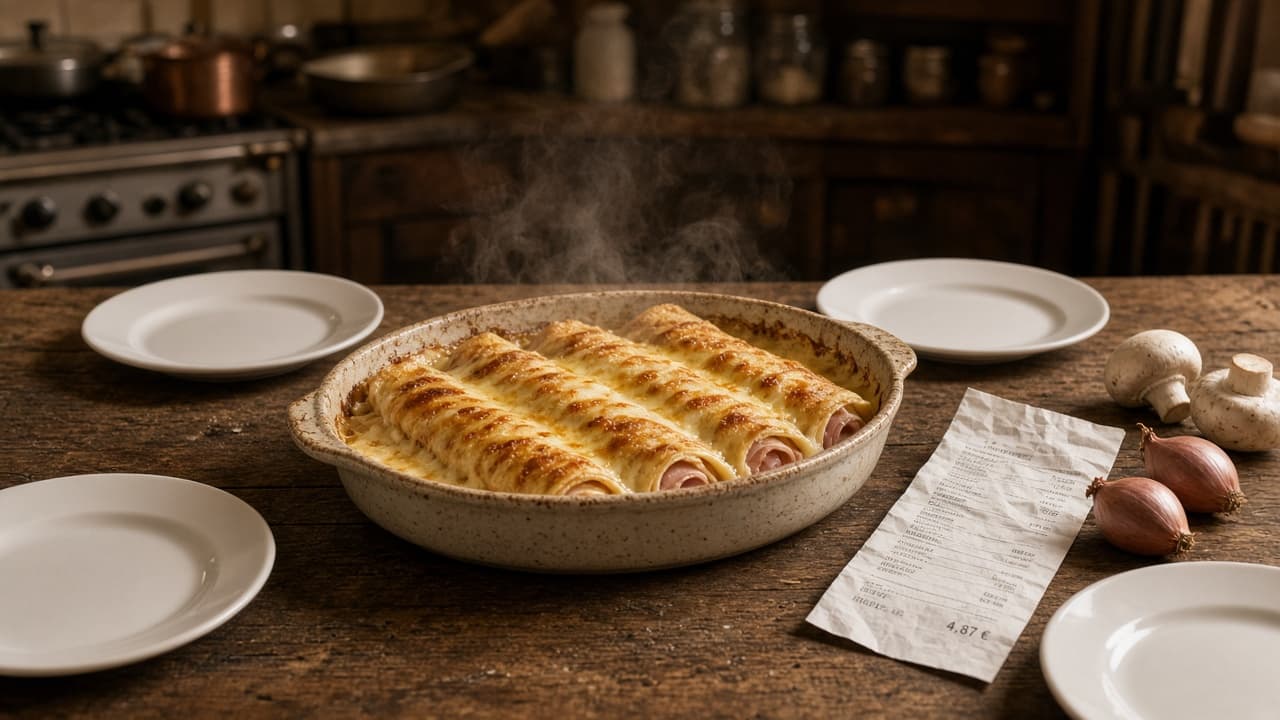
7 pm, shop still open. Six words in the JourX coach. The AI computes today’s budget, margin, goals, opens the fridge card, crosses ficelle picarde and plain crêpes, pushes missing items onto Home, puts dinner on the plan — and Marc, on his way home, taps “I take it”.
By Sébastien Fallet, founder of JourX8 October 202614 min
7:00 pm. The Intermarché in Friville-Escarbotin is still open. Julie is at home. Marc is coming back from work. Four at the table. No speech. Just hunger. She types six words into the JourX coach:
“Give me a recipe idea.”
Not a brief. Not “crisis dinner, €4.87, 4 people”. A rushed human sentence. That is why consumer AIs fail: they invent a dish. JourX is not allowed to. Behind those six words, the engine must rebuild the household state, pick a catalogue card, cross the batter if needed, then do the work: fill the Home list, put the meal on the plan — and notify the other adult, immediately.
That evening: ficelle picarde. Not an invented recipe. A cross.
- Card FR-HDF-012 — Ficelle picarde. Hauts-de-France. 4 portions. 25 min + 20 min in the oven.
- Card FR-BDG-071 — Plain crêpes. The batter. 6 people, ~12 crêpes. Flour, eggs, milk, butter, sugar.
Eight crêpes for the ficelle = 8/12 of the batter. New packs, empty cupboard: €22.99. After Julie’s fridge card: €4.87 missing. Dinner envelope: €5.75. Shop open. The list goes out. Marc, in the car park, gets the push. He taps “I take it.”
Here is the real process. Investigation. No jargon.
What the AI computes before it speaks
A generic AI hears “recipe idea” and serves garlic pasta. Zero receipt. Zero household. JourX only opens the catalogue after five figures.
1. Today’s budget. What JourX set tonight for today. Here: €40.00. Not the month. Not the salary.
2. What is already spent. Fuel, bread, coffee. €15.00. €25.00 left. Cooking on €40 would be a lie.
3. The meal — the time share. The question does not say “dinner”. At 7 pm, after 1 pm, the engine aims at evening. At 11 am it would be lunch — with a wider margin.
4. A margin rate. A reserve, as % of what remains. In the engine:
- Remaining €15–30: 10% before 1 pm, 5% after 1 pm
- Remaining > €30: 20% morning, 10% evening
- Remaining < €15: no margin — most generous that still fits, or cheapest if already in the red
At 7 pm, €25 left: 5% margin = €1.25. That euro-twenty-five is not for the plate. It is the cushion. The one banks bill at €8 the moment you burn it.
5. The daily share of goals. Holiday, safety, clearing overdraft: a per-day rhythm. Here €8.00 + €10.00 = €18.00. The coach does not “forget” them for a prettier dish.
Meal envelope:
25.00 − 18.00 − 1.25 = €5.75.
Five euros seventy-five. Cap on what is left to buy. A ficelle at €22.99 in new packs is out — unless the fridge and Home cut the ticket.
Forcing an AI means this: ban cooking on the salary. Give it €5.75, a real store, a household — and two cards to assemble.
Two cards, not a hallucination
The catalogue ficelle does not buy a pack of ready crêpes. The ingredient is called Crêpes, status HOMEMADE, cost €0. Without the second card that is a hole: the engine would pretend the batter does not exist.
JourX crosses.
FR-BDG-071 — Plain crêpes, for 6 people (~12 crêpes):
- Butter 40 g
- Eggs 4
- Flour 250 g
- Sugar 40 g
- Milk 60 cl
The ficelle needs 8 crêpes. The engine scales: 8/12 of the batter. Then it stitches the steps in order: batter first, filling after. One coutAAcheter. One list. Not two dinners. Not an invented pancake.
That is the gem ChatGPT does not have: read the catalogue like a cook, not like a blog.
Home: the shared brain — not a WhatsApp list
Before proposing the dish, the coach reads JourX Home.
Home is JourX’s household space. Not a joint account. Not a chat group. A place where the whole household sees the same thing, at the same instant:
- the members — here four: Julie, Marc, two children, set up in the household. The AI knows the headcount. It does not cook for an imaginary singleton
- the shopping list, with statuses: I ask → I take it → done
- the meal plan, lunch / dinner, day by day
- what is already marked bought — which the AI must cost at €0
At 7 pm: lunch is on the plan. The dinner slot is empty. Marc is not in the kitchen. He is in the car. The children, if they have a phone and JourX Home, are in their rooms — and Home exists for them too. Without a household, the AI invents a singleton with an empty fridge. With Home, it knows how many are at the table, what is planned, what is already paid — and who can still stop at the shop.
Home is not “the recipe”. Home is the household’s memory, and its hands.
The card: “What do you already have for this dish?”
The coach does not invent the fridge. It opens a card. Checkboxes. Tick only what you already have. Nothing ticked = you have none of this list.
Julie has the fridge of a Picard household that cooks. She ticks everything needed for the crêpes — flour, eggs, milk, butter, sugar — plus the cream and the ham.
She does not tick mushrooms. Not shallots. Not grated cheese.
The engine recomputes cost to buy — store packs, never “three spoons”:
- Crêpe batter (flour, eggs, milk, butter, sugar): already there → €0
- Cooked ham: already there → €0
- Crème fraîche: already there → €0
- Mushrooms: €2.59 for 400 g
- Shallots: €0.24 (2 pieces, loose)
- Grated cheese: €2.04 for a 200 g bag
- Missing ticket: €4.87
€4.87 inside €5.75. Both cards pass. And it is 7 pm: the shop is still open. So the AI does not ask “shall we do this tomorrow?”. It does the work.
Without the card, this crisis dinner does not exist: €22.99. With the card: Marc only buys what is missing. Crêpes are not on the list. Nobody sends Marc to the industrial pancake aisle.
Shop open: the list fills, the plan too
Two buttons. Two acts. Not advice.
1. Home shopping list. Mushrooms, shallots, grated cheese land as I ask. Julie sends no text. She does not write “can you grab Gruyère?”. The household already has the list. (In the catalogue it is not Gruyère: it is grated cheese, 200 g bag, €2.04. The AI does not lie about the label.)
2. Meal plan. Dinner is written in: tonight — Ficelle picarde. Card for 4. The household is set up for 4. The slot is no longer empty.
The push goes out. Marc, in the car. And, if they have a phone with Home: the children, from their rooms, get the same household notification: 🍽️ Meal planned: Dinner — Ficelle picarde. No mum text. No “what’s for dinner?”. Dinner is already written.
That is the switch ChatGPT never makes. Anyone can suggest a dish. Pushing the dish into the household, so everyone can act without a meeting — including from a bedroom — is the engine.
Marc comes home. The push. “I take it.”
Marc was not in the conversation. He did not read the coach. He does not need to.
The Home push hits the phone, still on the seat: 🛒 Julie added: mushrooms. Then shallots. Then grated cheese. Then, if the plan goes first: 🍽️ Meal planned: Dinner — Ficelle picarde.
He is outside Intermarché. Or two streets away. He opens Home. Three pending lines. He taps “I take it.”
Status flips: ✋ Taken. His first name shows. Julie, at home, sees Marc on the mushrooms, the shallots, the cheese. No double punnet. No “I thought you got it”. Household protocol, in the product: I ask → I take it → done.
She does not wait for him to walk in. Confirmation received: he took it. She starts the crêpes — batter first, as the two cards stacked it. When Marc opens the door with the receipt, the first layer of dinner is already on the pan.
In the aisle he ticks Bought. Real ticket, Friville prices: 2.59 + 0.24 + 2.04 = €4.87. Under the envelope. Under €5. Dinner is no longer an idea. It is a trolley. And the crêpes, already at home, cost nothing.
The bonus. The plain-crêpes card makes ~12 crêpes for 6 people. The ficelle only takes 8. Four remain. Dessert tonight — a little sugar, already in the batter — or tomorrow, another recipe, another Home slot. The engine did not throw the extra away. It scaled. A household of 4 that does not rebuy flour twice.
Why this ficelle — not an omelette, not an invented dal
The coach does not create FR-HDF-012. It selects it among 820 cards. Then it assembles FR-BDG-071.
The meal. 7 pm → dinner. Lunch already planned → it says so, it does not overwrite lunch.
The envelope. €4.87 cost to buy, after card, Home, and the cross. A €26 stew is out. A plain omelette is a 2-portion card. They are 4. The ficelle is a 4-portion card.
Generous, not skinny. If room remains inside €5.75: not the saddest dish. The most generous that still fits. The ficelle holds. A bowl of plain rice would too — that is not the job, and it is not here.
Intermarché prices, surveyed in Friville-Escarbotin. 431 products. Not a generated “around two euros”. Scraping is not a stunt: it is the ban on inventing a tariff.
Steps, untouched, in order. Melt the butter. Mix flour, eggs, sugar. Milk, then butter. Rest. Cook the crêpes. Then: fry mushrooms and shallots. Fill. Roll. Cream and cheese. Gratin. No pecorino. No “shop-bought crêpes”.
Remove one layer — the hour, the margin, the cross, Marc, the push — and this is no longer JourX. It is a recipe blog.
The two cards, unvarnished
Plain crêpes — FR-BDG-071. 6 people. ~12 crêpes. Dose used tonight: 8/12.
| Ingredient | Card qty (6 people) | Tonight (8 crêpes) | Friville price | At Julie’s |
|---|---|---|---|---|
| Butter | 40 g | ~27 g | €2.76 / 250 g | already there → €0 |
| Eggs | 4 | ~3 | €3.02 / 12 | already there → €0 |
| Flour | 250 g | ~167 g | €1.09 / 1 kg | already there → €0 |
| Sugar | 40 g | ~27 g | €1.75 / 750 g | already there → €0 |
| Milk | 60 cl | 40 cl | €1.26 / L from the pack | already there → €0 |
| Batter | €9.88 new packs | €0 |
Ficelle picarde — FR-HDF-012. France. Hauts-de-France. Easy. 4 portions.
| Ingredient | Qty | Intermarché Friville price | Format | At Julie’s |
|---|---|---|---|---|
| Crêpes | 8 pieces | HOMEMADE card → FR-BDG-071 | scaled batter | cross |
| Cooked ham | 4 slices | €5.61 | 350 g tray | already there → €0 |
| Mushrooms | 300 g | €2.59 | 400 g punnet | €2.59 |
| Shallots | 2 pieces | €0.40/100 g | loose | €0.24 |
| Crème fraîche | 30 cl | €2.63 | 35 cl pot | already there → €0 |
| Grated cheese | 100 g | €2.04 | 200 g bag | €2.04 |
| Missing ticket | 4 people | €4.87 |
New packs, empty fridge: €22.99. Above the envelope, above the month for many households. With the fridge + shop open + Marc: €4.87 leaves. Batter, ham, cream stay at home.
What this proves — the gem is not the crêpe
Every network knows a ficelle saves a Picard Sunday. The gem is the sentence that is too simple, two cards that talk, and Marc’s hand.
“Give me a recipe idea.”
Behind it: daily budget, already spent, time share, 5% margin, €18 goals, Home, fridge card, 820 recipes, two of them assembled, 431 prices from a Picard Intermarché. Then a list. A plan. A notification. An I take it button. A €4.87 ticket.
Bankin will tell you what Marc paid yesterday. ChatGPT will tell you what Julie might cook. JourX does the third job, the only one that exists at 7 pm with the shop still open: put dinner in the hands of the person who can still stop at the aisle, without a couple meeting — and without rebuying the flour.
Groceries remain #1 in remaining cash once housing is paid. Food: 12.3% of household consumption¹. Family of 4: ~€650/month². ADEME waste: up to €400/year³. A costed dinner, crossed, pushed to Home, is not a viral recipe. It is €400 not going in the bin, and €8 of bank fees not going to the bank — because nobody rebought the eggs, and Marc did not improvise an €18 trolley.
The finest part: JourX gets better every day
The finest part of this 7 pm scene is not the ficelle. It is not even the I take it button.
It is that JourX is not frozen.
Every day the product trains. The AI learns from real households — not a corpus of luxury recipes. Features move with the times: a tighter daily envelope, a shop still open at 7 pm, crossing cards, a household list, a meal plan, a push to the person coming home. The goal is not “a budget app”. It is to answer, tomorrow morning, a little better than yesterday, the hardships households actually live: trolley inflation, shrinking leftover cash, mental load that always lands on the same person.
An engine that computes €5.75 tonight, assembles two Picard cards, and sends Marc to the aisle is not a magic trick. It is an AI and a product improved continuously, to match this France — the one where 7 pm is no longer the hour to improvise a trolley.
FAQ
How does JourX pick a recipe from “give me a recipe idea”?
It does not generate a dish. It computes the envelope: remaining daily budget, minus daily goals, minus the hour-based margin. Then it filters cards on cost to buy, after Home and the fridge card. That evening: ficelle picarde, crossed with the plain-crêpes card.
Why cross two cards?
The ficelle’s crêpes are a HOMEMADE ingredient at €0. Without the plain-crêpes card, the engine would forget the batter — or invent a pack. The cross scales 8/12, merges the steps, one ticket.
What happens at 7 pm if the shop is still open?
The AI pushes missing items onto the Home shopping list (I ask status) and writes the dish on the meal plan. The other adult gets a household notification immediately.
What is the “I take it” button?
On the Home list: I ask → I take it → done. “I take it” reserves the item. The first name shows. No double buy. In the aisle you mark “Bought”.
What is JourX Home?
The shared household space: members, list, lunch/dinner plan, pushes. The AI knows the headcount (here 4: two adults, two children set up). Anyone with Home on their phone — including a child in their room — gets the dinner notification.
What is the ingredient card for?
To validate fridge and cupboard. Checkboxes. At Julie’s: batter + ham + cream already there. It turns €22.99 in new packs into €4.87 of missing items — the only ticket that counts against the €5.75 envelope.
How do the margin and goals enter dinner?
Goals with a deadline = per-day amount, subtracted before cooking. Margin 5–20% by hour and remaining cash: cushion, not plate. The envelope is what remains after both.
What happens to leftover crêpes?
The plain card makes ~12 crêpes; the ficelle only takes 8. About 4 remain: dessert tonight, or another recipe another day — without rebuying flour.
Does JourX really improve every day?
Yes. The AI trains, features move with the economic weather and household hardship: daily budget, Home, crossing cards, pushes. The €4.87 dinner is not a one-shot. It is a product that learns, to match this France.
Sources
- Share of food in household consumption spending (12.3% in 2024) — INSEE
- Food budget family of 4, ~€650/month — Plan & Multiply / INSEE
- Food waste €100–160/person/year, up to €400/year for a household of 4 — ADEME
- JourX engine: envelope = remaining today − daily goals − (remaining × rate); Home: list I ask → I take it → done, plan, household push; HOMEMADE → base card cross; FR-HDF-012 Ficelle picarde + FR-BDG-071 Plain crêpes; 431 Intermarché Friville-Escarbotin prices
- Courrier Picard, 29 September 2025, Friville-Escarbotin
Six words. 7 pm. Shop open. €5.75 envelope. Two cards. A fridge check. A list. A plan. Marc taps I take it. The engine was not creative. It was exact. And the finest part: tomorrow it will be a little fairer still — because JourX gets better every day.
Try the recipe coach — 30 days free →
Try JourX free for 30 days — no credit card required.
One daily number that adapts to your reality — no fixed categories to force into place.
Start 30 days free →Then €5.99/month. No bank connection. No fixed categories to explode.