Couple budget: why it fails — and how to fix it in 2026
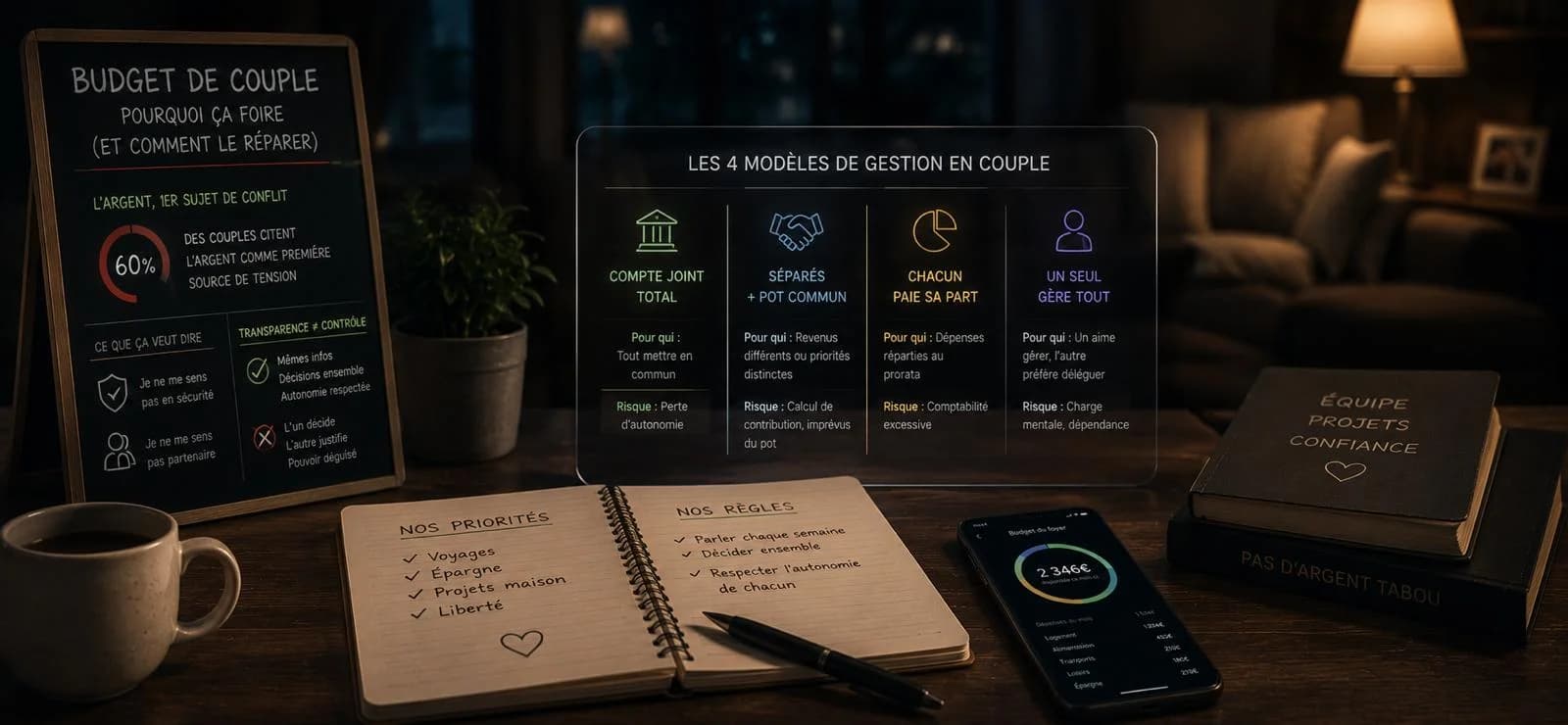
Couple budget and money fights: the top source of conflict, not from lack of love — from lack of tools. Joint account, shared pot, daily budget: what actually works.
By The JourX newsroom28 June 202613 min
Sophie and Julien, three years together, planning to move in — and fighting about money. Not every day, but enough for the same line to return: "How much did you spend again?" It's not love or character. It's tools and transparency. Here's what couples who make it work do differently.
Money, the number one source of conflict in relationships
The numbers
In more than 60% of couples surveyed across Europe, money tops the tension list — before children, work, in-laws.
It's not poverty: households on €6,000/month argue as much — sometimes more — as those on €2,000. The variable isn't the amount. It's transparency.
What "we fight about money" really means
"You spend too much" = "I don't feel safe." "You control everything" = "I don't feel like a partner."
Money is the vector. Emotion is the conversation. Until you talk security and fairness, not just numbers, the conflict stays.
Transparency vs control
Healthy transparency: same data, decisions together, individual autonomy preserved.
Control: one decides, the other justifies. Power disguised as budgeting.
The 4 couple money management models
No universal model — income, temperament, and goals decide.
Select the model that best matches your situation:
Best for Different incomes or distinct priorities.
Risk Contribution math (50/50 vs proportional), pot surprises.
Model 1 — Fully joint account
All income, all spending. No "my money / your money."
Best for: similar incomes, strong trust, same priorities.
Risk: lost autonomy, feeling watched, messy breakup.
Model 2 — Separate accounts + shared pot
Personal accounts plus monthly contribution to joint bills.
Best for: different incomes or spending priorities.
Risk: fair split (50/50 or proportional?), shared-pot surprises.
Model 3 — Each pays their share
No joint pot. "I pay rent, you pay electricity."
Best for: newer couples, strong independence.
Risk: daily friction, no shared vision.
Model 4 — One person manages everything
One partner runs finances; the other gets an "allowance."
Best for: single income or large skill gap.
Risk: power imbalance, dependence.
The 3 classic mistakes
The monthly budget nobody looks at
You made it together one Sunday evening, motivated. By the 8th of the month, nobody remembers it. A budget that isn't checked daily doesn't exist.
Rigid 50/50 when incomes are unequal
If one person earns €2,000 and the other €1,200, splitting expenses 50/50 breeds resentment. A fair contribution is proportional to income — not arithmetically equal.
Grocery shopping without a list or budget
The top source of daily conflict. Who buys what? Why name brands? Why 3 packs of pasta? A real-time shared list eliminates 80% of these tensions.
What actually works
Real-time transparency
Month-end reviews come too late — the spend is done, the balance red, the talk becomes a trial.
See the same information every day: same daily budget, same list, same goals. Information is shared, not fought over.
A visible shared goal
Holiday, down payment, car, emergency fund — when the goal is concrete, "I'm not buying those shoes" becomes "we're getting closer to the holiday."
The "no questions asked" envelope
Each person keeps a monthly amount spent without justification — €10, €30, €50 depending on means. Autonomy respected, personal micro-conflicts gone.
The 10-minute Sunday check-in
- Where are we on our goals?
- What unexpected expenses this week?
- Do we adjust anything?
Ten minutes. Regular. No judgment.
The daily budget as a couple
The formula stays the same:
The power is sharing: "We have €35 today — go out or eat at home?" A conscious decision together, not a fight.
Calculate your daily budget as a couple:
58,33 €
daily budget for two
That's 29.17 € per person with equal split
JourX Home — the shared list
Real-time shared grocery and meal list. One link, no account required. No duplicates, no "did you get milk?"
The hard conversations
How to talk about money without fighting
Never when tired, stressed, or mid-task. Pick a neutral moment — not after a long day or a panicked balance check.
The 3 phrases to never say
"You always spend too much" → "We went €40 over this week — what happened?"
"It's my money" → shared resources plus personal envelopes, not two separate worlds.
"We'll see at month-end" → decide now with today's information.
Budget meeting script (10 min)
1-2: shared pot balance and week's spending — observe.
3-5: expected expenses, amounts.
6-8: shared goals — on track or behind?
9-10: one decision: watch restaurants or allow a treat.
Sophie and Julien, 2 months later
Shared grocery list. Visible Spain goal €1,200. €40 "no questions asked" each. Sunday 9pm, ten minutes together.
They no longer fight about money — not because they earn more, because they see the same reality at the same time.
FAQ
How to manage budget as a couple?
The most balanced model: each person keeps a personal account and contributes to a shared pot for joint bills. Real-time spending transparency avoids conflicts.
Joint account or separate accounts as a couple?
Separate accounts with a shared pot offer the best balance: individual autonomy and shared transparency. JourX Home lets you share shopping lists without a joint account.
Try JourX Home — 30 days free →
JourX Home lets you share grocery lists, meals, and shared goals with a simple link — no account required.
30 days free. No credit card. No commitment.
Because money shouldn't be what drives you apart.